Bird box
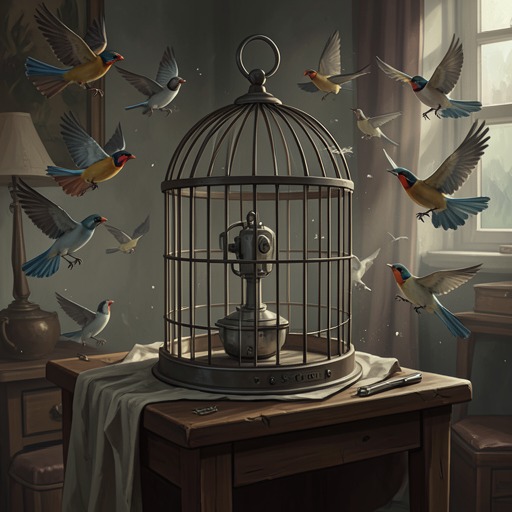
Bird BoxThe Bird box is an exterior container for birds that turns their calls into a warning system for people who must avoid looking outdoors. Its role depends on listening: the birds announce proximity and possible disturbance, while their changing calls help Malorie and the children interpret an unseen environment. But the signal is not infallible. Wind can sound like the box striking the house, and the birds themselves can become caught up in the catastrophe they once helped people monitor.
Form and Everyday Use
At the Shillingham house, the Bird box is mounted outside near the front walk. Cheryl finds it by feeling along the coarse brick wall until it gives way to wood paneling and a protruding metal hook. She approaches blindfolded with apple slices taken from a can in the cellar, using the house wall for balance as she walks slowly toward the birds.
Cheryl volunteered to feed them and does so every day. She speaks to them about ordinary events inside the house, and their cooing comforts her. The birds also give her a practical measure of distance: she can tell how close she is to the box by how loudly they sing. In a household organized around blindness, the box is not simply a container but a fixed point in a route navigated by touch and sound.
A Warning Made of Sound
The birds’ calls establish a baseline against which other sounds can be noticed. When Cheryl hears an unexplained step at the end of the front walk, she describes it as an “abandoned step”: a sound suggesting that someone began to walk onward and then stopped. The account does not establish who, if anyone, made it, but the contrast between familiar cooing and a sudden irregular sound makes the approach to the box a site of vigilance as well as care.
The wider survival system also depends on interpreting sounds without seeing their sources. On the river, Malorie listens to birds, splashes, and the movement of the surrounding world; the children have been trained from infancy to identify sounds in the forest while blindfolded. In that context, birds can contribute to the landscape’s audible information, but listening does not make the danger visible or fully knowable. The same sound that offers orientation can intensify uncertainty about what is nearby.
False Alarm and Recognition
During the river journey, Malorie thinks she hears the Bird box lightly banging against the house, only to recognize that the sound is wind against the window. The moment shows how easily a warning system can be confused with ordinary environmental noise. The birds’ calls are not a perfect code; their meaning must be judged against other sounds and the immediate setting.
Later, the Girl says that she cannot hear because the birds are too loud. Malorie stops rowing and asks what the children hear. She then discovers a dead bird by touch and realizes that birds in the sky are attacking one another. This change in the soundscape turns the birds from reassuring callers into signs of crisis. Their calls no longer provide a stable, calm measure of the outside world; the birds themselves are affected by the danger.
Narrative Significance
The Bird box concentrates the book’s dependence on hearing into a tangible object: its presence outside can be inferred from calls and, at times, from the box knocking against the house. That auditory clue can be misleading when wind produces a similar sound, and the birds’ own distress eventually compromises their usefulness as a warning. The object therefore embodies both the necessity and the limits of listening as a substitute for sight.
Its function also changes across settings. At the house, Cheryl’s daily care makes the birds familiar companions whose voices calm her and help her locate the box. On the river, bird calls form part of the environment that Malorie and the children must interpret while remaining unable to look. When the Girl reports that the calls have become overwhelming and Malorie identifies a dead bird, the warning system becomes evidence of a wider collapse: what had helped the survivors listen for danger is itself caught within it.